 Save
SaveSomewhere in almost every older house is a window that hasn't opened in years — painted shut by one repaint too many. And every year, someone cracks a pane, splits a sash, or throws out their back trying to force one open.
Here's the thing: that window isn't stuck. It's glued — a dried paint seam runs the full perimeter of the sash, bonding it to the frame like a bead of adhesive. Force doesn't defeat glue; cutting does. With the right 10 minutes of knife work, the window opens with two fingers.
What you need (about $15 total)
- Utility knife with a fresh blade
- Stiff putty knife (metal, not plastic)
- A hammer (to tap the putty knife, not the window)
- Optional but excellent: a serrated paint zipper (~$5), a tool made exactly for this job
Step 1: Cut the paint seam — every inch of it
 Save
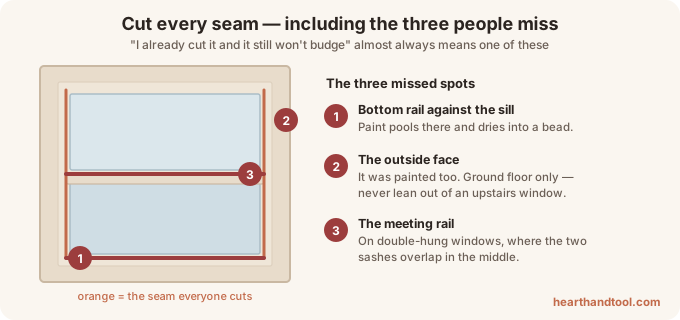
SaveRun the utility knife along the line where the sash (the moving part) meets the frame and the stops — down both sides, across the bottom, and along the inside face where the sash meets the interior stop molding. Keep the blade angled into the seam, and make two or three passes rather than one deep cut.
The most-missed spots, and the reason "I already cut it and it still won't budge":
- The bottom of the sash where it meets the sill — paint pools there
- The outside of the window, which was probably painted too (do this from outside if it's a ground-floor window; don't lean out of an upper-story window for it)
- The meeting rail in the middle, if it's a double-hung window
Step 2: Break the bond with the putty knife
Slide the putty knife into the cut seam and tap it gently deeper with the hammer, then rock it slightly. Work your way around the entire sash — you're not prying, you're wiggling a wedge along the seam to crack any paint the blade missed. On stubborn seams, tap the putty knife in at several points along each side.
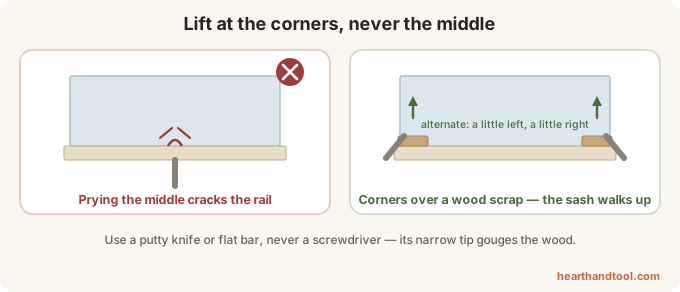
Never use a screwdriver for this step. Its narrow tip concentrates force into one spot and gouges the wood — the wide, thin blade of a putty knife spreads the force and leaves no marks.
Step 3: Persuade it open — from the outside if possible
 Save
SaveNow try lifting with both hands, palms flat against the sash rails (the frame of the sash, never the glass), with a gentle upward bump rather than a slow strain.
Still stuck? Go outside: place a flat pry bar (or the putty knife) under one bottom corner of the sash, over a scrap of wood on the sill to protect it, and lever gently. Alternate corners — a little lift left, a little lift right. The sash walks upward. Prying hard in the middle of the bottom rail is how sashes crack; corners are where the frame is strongest.
Step 4: Make it glide (so this never happens again)
Once open, the window will likely still drag — the old paint left ridges in the channels.
- Scrape any paint ridges out of the side channels with the putty knife.
- Sand the channels lightly with 120-grit.
- Rub the channels with paraffin wax, an old candle, or dry lubricant spray. The sash should now glide like it's 50 years younger.
The prevention rule
Next time you paint window frames: paint with the sash slightly open, and move the window a few inches up and down twice while the paint dries (at the 1-hour and 3-hour marks). That breaks the forming seal before it cures. A painted-shut window is never a window problem — it's a painting-technique problem, and it's entirely preventable.