 Save
SaveColor drenching — painting the walls, trim, doors, and often the ceiling in one single color — is everywhere right now, and for once the trend actually has solid logic behind it. In a small room, contrast is the enemy: every place where wall color stops and white trim starts draws a line, and every line reminds your eye how close the walls are. Remove the lines and the edges of the room visually dissolve.
Designers have used this trick for decades in powder rooms and studies. What's new is people applying it to bedrooms, hallways and living rooms — and discovering that a drenched room in the right color feels both bigger and cozier at the same time.
Why it works (the 30-second theory)
Your brain measures a room by its boundaries: where walls meet ceiling, where trim breaks a wall. High contrast makes those boundaries loud. When everything wears the same color, boundaries go quiet, corners soften into shadow, and the room reads as one continuous volume instead of a box with visible limits.
This is also why the old advice — "paint small rooms white to make them bigger" — often backfires: white walls with even whiter trim and stark shadows can make a small room look like a bright little box. A drenched mid-tone room hides its own corners.
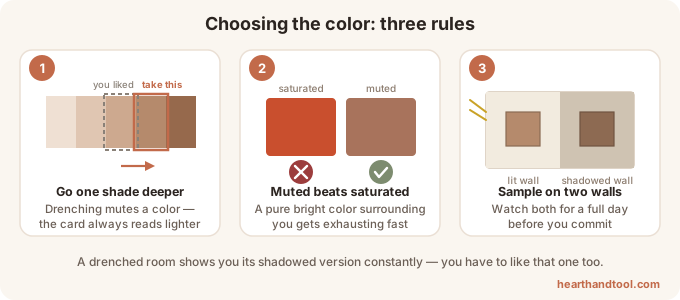
Choosing the color: three rules
 Save
Save- Go one shade deeper than you think. Drenching flattens contrast, which slightly mutes a color's impact. That swatch that feels "a bit much" on the card usually lands exactly right on four walls and a ceiling.
- Muted beats saturated. Colors with a little gray or brown in them — sage, terracotta, olive, clay, dusty blue, mushroom — wrap a room without shouting. Pure bright colors surround you in a way that gets exhausting.
- Sample on two opposite walls. Paint a 2-foot square on a wall that gets window light and one that doesn't, and watch both for a full day. A drenched room shows you its color in shadow constantly, so you need to like the shadowed version too.
 Save
SaveWhich finish goes where
 Save
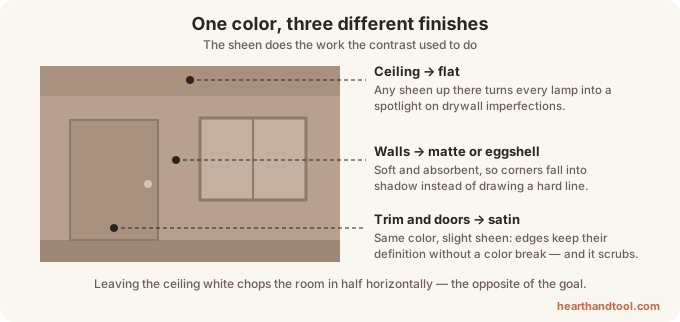
SaveSame color does not mean same paint. Use the finish to do the work the contrast used to do:
- Walls: matte or eggshell
- Trim, doors and window frames: the same color mixed in satin or semi-gloss — the subtle sheen difference gives edges definition without a color break
- Ceiling: flat, always. Any sheen up there turns lamps into spotlights on every drywall imperfection.
How to paint it (order matters)
- Clear and mask the room. With one color you can be faster with tape, but window glass and floors still need protection.
- Ceiling first. Cut in the edges with a brush, then roll. Two coats.
- Walls second. Cut in against the still-drying ceiling line — with one color, a slightly imperfect line is invisible, which is why drenching is actually easier for beginners than two-tone painting.
- Trim and doors last, with the satin/semi-gloss version. Lightly sand glossy old trim first so the new coat grips.
How much paint you'll need
A drenched room takes more paint than a normal repaint because the ceiling and trim join the party — typically one extra gallon per room. For a standard 10×12 ft bedroom with an 8 ft ceiling, plan on roughly 2 gallons of wall/ceiling paint plus a quart for trim, at two coats. Skip the guesswork and run your exact room through our free Paint Calculator — it accounts for doors, windows, coats and price per gallon.
 Save
SaveThree mistakes that ruin the effect
- Leaving the ceiling white. A white ceiling over drenched walls chops the room in half horizontally — the opposite of the goal. If painting the ceiling truly isn't an option, take the wall color to a warm off-white ceiling, not stark white.
- Drenching with cheap flat paint everywhere. Trim painted in wall-grade flat paint scuffs immediately. Spend the extra $10 on proper satin for the woodwork.
- Stopping at the door. Paint the door and its frame too. A white door in a drenched room glows like a movie screen.
Rooms where it works best
Small bedrooms, offices, hallways, dining rooms and powder rooms are ideal candidates — spaces where you want enclosure to feel intentional. In kitchens it works beautifully on the wall-and-cabinet combo. The one place to think twice: very large, very bright open-plan spaces, where drenching can read as flat rather than cocooning.