 Save
SaveSmall bedrooms punish clutter and reward strategy. The good news: how big a room feels has surprisingly little to do with its square footage — it's about sight lines, light, and how much visual noise the eye has to process. Here are nine changes that work, starting with the free ones.
1. Get the bed off the window wall (free)
 Save
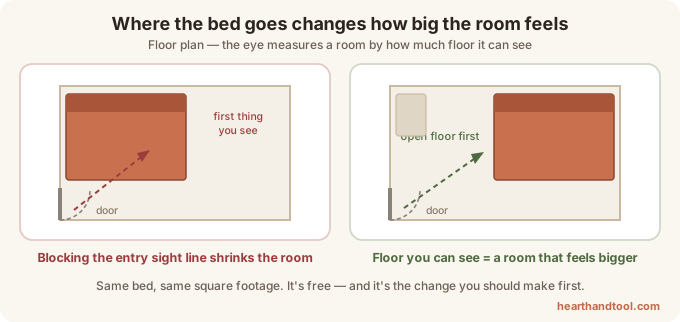
SaveThe bed is the biggest object in the room; where it sits decides everything. The ideal spot is the wall you don't see first from the doorway, headboard against it. When you walk in and see open floor before you see bed, the room reads bigger — it's a sight-line trick hotels use in every compact room.
2. Declutter the floor, ruthlessly (free)
The eye measures a room by how much floor it can see. Shoes, boxes, the chair-of-clothes — every object standing on the floor shrinks the room. Thirty minutes and a donation bag beat a hundred dollars of any other upgrade on this list.
3. Warm, layered light instead of the ceiling glare ($20–60)
One cold overhead bulb flattens the room and hardens every shadow. Replace it with 2700K warm bulbs and add two low light sources — a bedside lamp and a corner lamp. Three warm pools of light create depth that one ceiling fixture never will.
 Save
Save4. The big leaning mirror ($40–150)
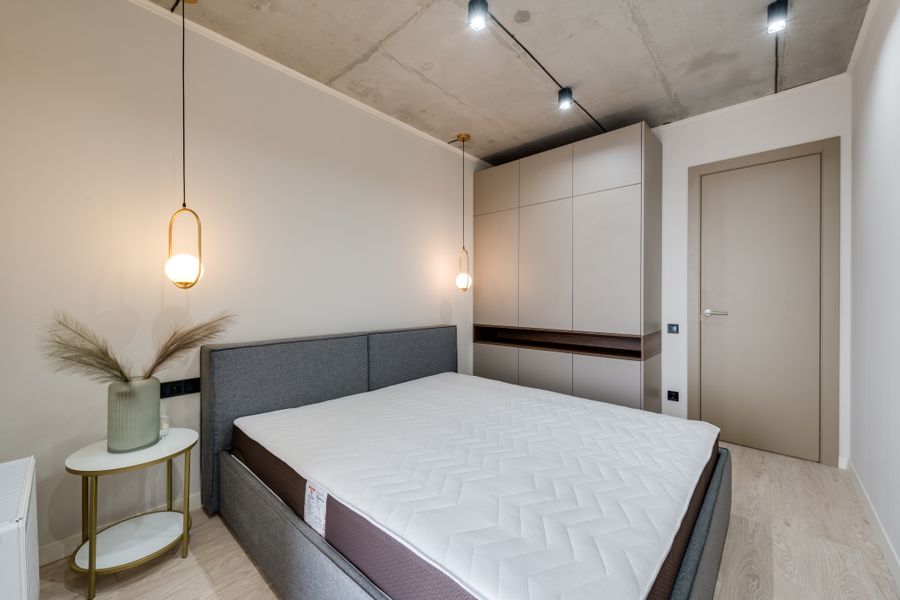
One large mirror — leaning, not hung, if you rent — placed to reflect the window or a lamp. It doubles the perceived light and adds a "second room" of depth. Never point it at the closet or the busiest corner; mirrors amplify whatever they see.
5. Curtains: high, wide, and the same color as the walls ($30–80)
Rod near the ceiling, extending well past the window frame, curtains long enough to kiss the floor. Choosing a curtain color close to the wall color keeps the wall visually continuous — contrast curtains chop the wall into panels.
6. Bedding in quiet colors ($40–100)
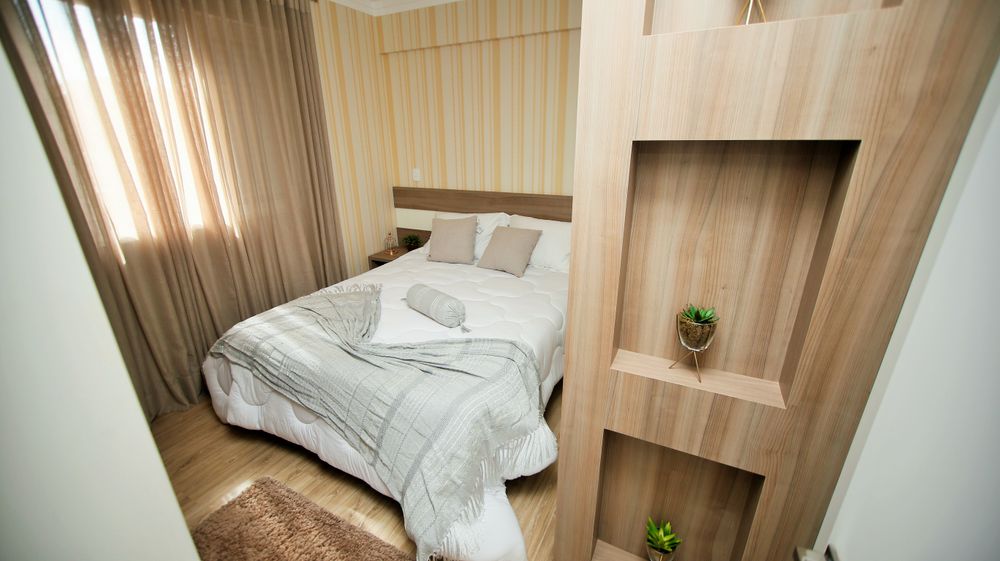
The bed is a third of the room's visual field. Busy patterned bedding = a room that always feels loud. A duvet in white, oatmeal, sage or a muted tone calms the whole room instantly, whatever else is going on.
7. Float the nightstands ($30–90)
Wall-mounted shelves or slim-leg nightstands instead of boxy cabinets. Visible floor under furniture is the same trick as rule 2 — the more ground the eye can trace, the bigger the perimeter feels.
8. Go vertical with storage ($50–150)
A tall narrow bookcase beats a wide short one; hooks and shelves near the ceiling pull the eye upward and use the room's most wasted resource — its height. Under-bed boxes swallow the off-season wardrobe.
9. The paint move: color drenching ($60–120)
The counterintuitive finale: a small bedroom painted in one continuous muted color — walls, trim, and ceiling — feels bigger than a white one, because the corners and edges dissolve. It's called color drenching, it's the best paint trick for small rooms, and we wrote the full how-to guide here. Run your room through the paint calculator first — a drenched room needs about one extra gallon.
The order to do it in
Free moves first (1–2), light third (3), then one or two purchases where your room is weakest. Most small bedrooms are transformed for under $200 total — the square footage never changes, and somehow the room does.